Where the Drain Says Otherwise: Fenland Lights and the Haunting of Engineered Ground
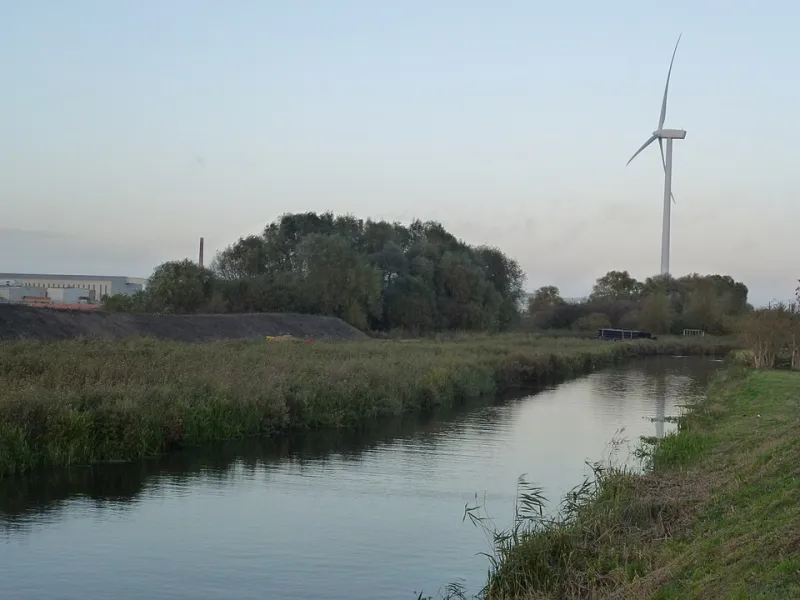
Photo: Richard Humphrey , CC BY-SA 2.0, via Wikimedia Commons
The fenland horizon is not empty. It is edited. A line of poplars, a distant pump house, a drain running ruler-straight towards a sky the colour of pewter: these are the marks of a landscape that has been argued with. The map says drain. The eye says field. The folklore says water. In that disagreement lies one of Britain's most persistent eerie presences: the marsh light, the will-o'-the-wisp, the lantern that leads a walker away from the path and into ground that was never as solid as it looked.
The Light Beyond the Lode
Fenland lore is rich in lights. They are called jack-o'-lanterns, corpse candles in neighbouring traditions, ignis fatuus in the older learned literature. They hover over wet ground, lure travellers from safe routes, and vanish when approached. The scientific explanations are familiar: marsh gas, phosphorescence, the combustion of organic matter, an optical trick of low horizons and tired eyes. None of these explanations has entirely displaced the older account, because the older account describes something the landscape still seems to promise. A light where the map says drain is not simply a chemical event. It is a small rebellion of the wet against the surveyed.
The fens have always been a place where water and land negotiate. Before the great drainage schemes, the season decided which was which. Reed beds, meres, silt, summer pasture and winter flood made a shifting country. The will-o'-the-wisp belongs to that older uncertainty. It is a light without a household, a flame without a hearth, a guide that is also a warning. To follow it is to trust a landscape that has not agreed to be trustworthy.
The Ground That Was Made to Forget
The engineering of the fens is one of Britain's great acts of geographical will. From the seventeenth century onwards, drainage schemes cut through the marsh, straightened rivers, raised banks and installed windmills, then steam pumps, then diesel and electric pumps. The Great Level was divided, sold, named and farmed. The land sank as the peat shrank, so that some fields now lie below the level of the sea. The pumps must run to keep the present arrangement in place.
This is not a background detail. It is the central fact of the fenland uncanny. The ground has been made to forget water. It has been renamed into drains, lodes, delphs and banks. It has been surveyed into geometric parcels. Yet the older water is not gone. It is held back, channelled, lifted and expelled. The landscape is not dry; it is drained. The difference matters. A drained place is a place under management, and management is always a kind of tension.
A Submerged Second Version
What happens to a haunting when the ground itself has been engineered? The fenland answer seems to be that the haunting moves into the infrastructure. The pump house becomes a mechanical breath. The straight drain becomes a line drawn through an older map. The light is seen where a mere once lay, or where a channel was filled, or where the water table rises after rain. The ghost is not necessarily a person. It may be a former surface.
This is why the fen feels like a place with a submerged second version. The first version is the one on the signposts: the village, the farm, the road, the drain. The second is the one the body remembers when the mist comes down and the horizon loses its edges. In that second version, the land is still wet, the paths are unreliable, and the lights are still out there, doing whatever lights do when no one is watching.
The Pump as a Kind of Exorcism
Drainage can be read as a long exorcism of marsh. Water is the unwanted presence; the pump is the ritual that removes it. The windmill, the steam engine and the electric pump are successive technologies of disposal. They do not persuade the water to leave. They lift it and send it elsewhere. The fenland landscape is therefore full of absences that are kept absent by constant work.
That work is not invisible. It hums. It opens sluices. It maintains banks. It is a form of collective vigilance, and vigilance is close to superstition. The pumps must not stop. The banks must not fail. The map must not be allowed to become wet again. In 2026, with flood risk and peat loss part of the public conversation, the old fear of the marsh has returned in administrative clothing. The light beyond the lode is no longer only a folk tale. It is a reminder that the engineered ground is a promise, and promises can be broken.
The Light That Refuses the Survey
The will-o'-the-wisp persists because it refuses to be fully surveyed. It is not a ghost with a name and a datespan. It is a phenomenon of ground and weather, a rumour of combustion, a story told to children and repeated by adults who are not entirely joking. It belongs to the fen's submerged second version, the one that the drains were meant to cancel.
To walk the fens at dusk is to feel the argument continuing. The land is orderly, productive and mapped. The sky is vast. The water in the drain is black and moving. Somewhere ahead, a light might appear where the map says drain, and the walker must decide whether to trust the survey or the story. The eerie is not that the fen is haunted. It is that the fen has been made, and making is never quite the same as forgetting.