Counting Past the House: Britain’s Absent Number Thirteens
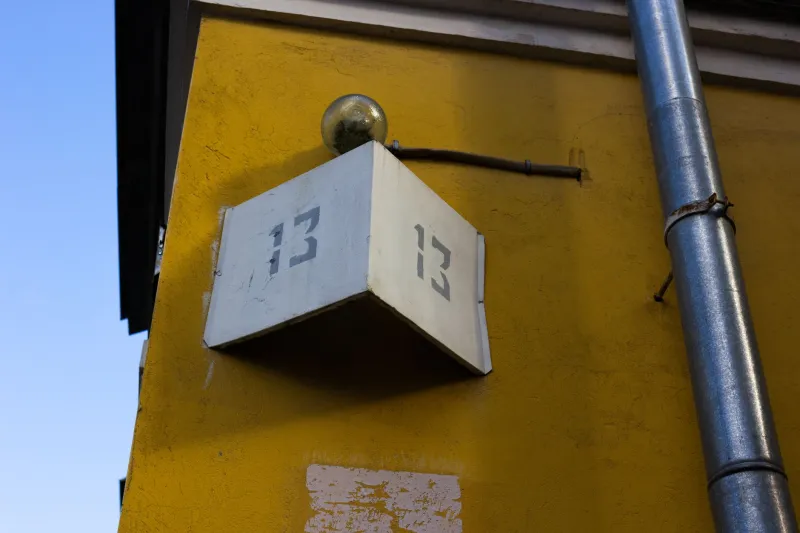
There are streets in Britain where the houses count aloud and then falter. Twelve gives way to fourteen; the door that should stand between them is either absent, renamed, or quietly folded into its neighbour. The effect is not dramatic. It is barely noticeable at first, which is precisely why it lingers. A sequence of numbers is a small promise of order, and a missing thirteenth address is a promise broken in the most ordinary handwriting.
The Gap Between Twelve and Fourteen
Walk a terrace at dusk and the numbering becomes a kind of litany. Twelve has a brass numeral, a pot of winter pansies, a doorbell that glows faintly. Fourteen has a wheelie bin and a mat that says nothing in particular. Between them is a stretch of brick, a downpipe, perhaps a narrow passage. There is no thirteen. The eye looks for it anyway. The mind supplies a door, a lintel, a knocker, a shadow under the door that could be a draught.
This is not a national law of architecture. Many British streets include a number thirteen without incident, and many more contain addresses that never proceed in a neat sequence at all. Odd and even sides, named houses, converted flats, backland infill: the British address is a palimpsest rather than a grid. Yet the omitted thirteen has a particular charge. It sits at the meeting point of superstition, commerce and municipal procedure, and it produces the kind of unease that British horror has always preferred to fog or thunder. The uncanny here is not a skull on the door. It is a gap in the sequence.
Three Ways to Lose a House
The missing number tends to appear in one of three forms. The first is the clean skip: twelve is followed directly by fourteen, and no explanation is offered on the street. The second is the compromise of 12A, 12B or 12½, an address that acknowledges the gap while declining to name it. The third is absorption, where a thirteenth plot has been merged into a neighbour, so that the door is gone but the outline of a former entrance may remain in the brickwork.
Local historians tend to find the same ingredients in each case. A developer submits a plan; a street naming and numbering officer considers it; a number is omitted or revised. Sometimes the reason is practical: the plot is too narrow, the access is awkward, the terrace was built in phases. Sometimes it is commercial: a house numbered thirteen may be thought harder to sell, though the evidence for this is more anecdotal than actuarial. And sometimes it is simply custom, the sort of custom that no one records because no one thinks to record it.
The Paperwork of Superstition
Council records rarely contain a memo announcing that thirteen has been avoided for supernatural reasons. The paper trail is duller than that. A plan is amended. A number is struck out. A letter refers to ‘the proposed omission of No. 13’ in the same tone it might use for a bin store or a boundary wall. Royal Mail’s address databases record what exists rather than what ought to exist, so a missing thirteen becomes a simple gap in the data. The postal system does not mourn it. The street, however, may keep the shape of it.
This is where folklore enters by the side door. Officialdom may insist that the omission is a matter of layout, amenity or precedent, but residents inherit a different kind of knowledge. They know which house is ‘the one that isn’t there’. They know that the gap between twelve and fourteen catches the wind. They know that deliveries sometimes hesitate at the pavement, looking for a number that the map says should be present. Such details are not proof of anything. They are the small friction between paper and place, and friction is where stories begin.
A Small Structural Haunting
In fiction, an absent address is an invitation. A house that cannot be numbered is a house that cannot be fully entered into the record, and British horror has long understood that bureaucracy is a more reliable source of dread than a ruined abbey. The ghost story that trusts a buff envelope also trusts a missing line in a ledger. The omitted thirteen is a hole in the map that memory fills with a door, a resident, a light left on.
As of 2026, the practice persists in streets across the country, though it is patchy and local. A terrace in a northern town may skip thirteen while a suburban avenue nearby includes it without comment. The variation matters. It suggests that the missing number is not a grand folk taboo but a series of small decisions, each made in a particular office by a particular person, and each leaving behind a trace that residents can feel even when they cannot name it.
Counting Past the House
The absent thirteenth address is not a ghost. It is a decision, or a cluster of decisions, preserved in brick and paperwork. But decisions leave shadows. The numbering system insists that the house is not there; the street suggests otherwise. Between those two claims sits a small, civilised haunting, the kind that does not rattle chains but simply waits in the gap between twelve and fourteen, counting past itself.
To walk such a street is to be reminded that addresses are stories we agree to tell. When one is omitted, the story does not stop. It merely lowers its voice.