The Item Deferred: Village Halls, Parish Minutes and the Eerie Comfort of Procedure
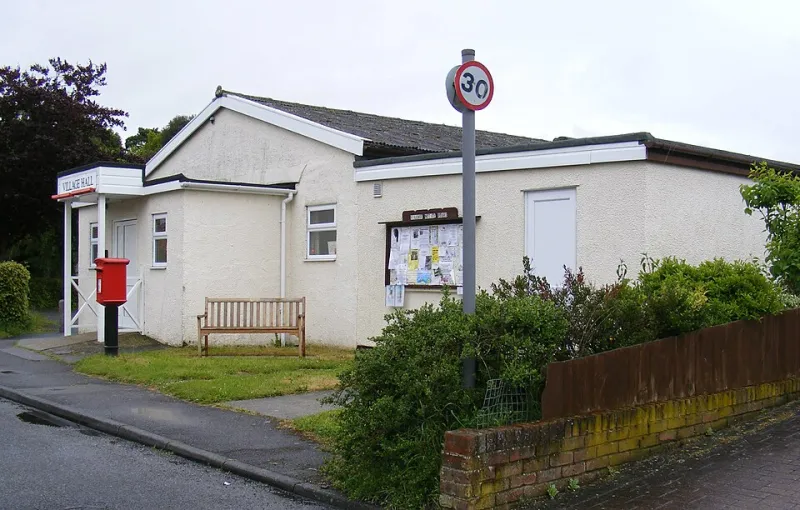
Photo: Geographer , CC BY-SA 2.0, via Wikimedia Commons
The Noticeboard as Threshold
A village hall noticeboard is rarely admired. It is a cork rectangle in a porch, behind glass, held shut with a small brass lock that has been painted over at least twice. On it: a pilates class, a parish council agenda, a poster for a harvest supper, a handwritten card advertising eggs, and a laminated warning about parking on the green. The notices overlap. They curl at the corners. A date has been altered in biro, then altered again in a different biro. Someone has written “ALL WELCOME” at the bottom of a meeting notice in a hand that suggests they were not entirely certain.
Such boards are threshold objects. They stand between the private and the civic, between the informal and the minuted. They are also anthologies of small dreads. The notice that has been there so long its drawing pins have rusted. The agenda with one item blanked out. The caretaker’s number written inside the key cupboard door, in biro, with no name attached. These are the traces of a committee that has met, will meet, and may not have finished meeting.
Apologies for Absence
Parish council minutes are a literature of the provisional. “Apologies for absence were received from Councillor —.” “Matters arising: item deferred.” “The meeting closed at 9.14 p.m.” The formality is comforting; the repetition is not. A quorum is reached, a motion is carried, a clerk writes it down. The language is flat because it must be. It records rather than interprets. It is the opposite of gothic prose, and that is precisely why it can be made to frighten.
Every set of minutes contains the possibility of error, omission, or an item that returns, year after year, like a ghost that cannot find rest. “Item deferred” is a kind of haunting: it promises a future in which the matter will be settled, while quietly admitting that it has not been. The same phrase appears in 1973, in 1998, in 2026. The same allotment gate, the same broken clock, the same boundary dispute with the neighbouring parish. The committee changes; the item remains.
The Key Cupboard
The key cupboard is a small locked room within a larger locked room. Inside: spare keys on a faded fob, a fuse box, a first-aid kit, a tin of instant coffee, and a number written in biro. The number belongs to the caretaker. Who is the caretaker? The minutes refer to “the caretaker” without elaboration, as if the role were self-evident. The number may be disconnected. It may be answered by someone who says they are on their way. It may belong to a person who has not held the role since the hall roof was last repaired.
Bureaucracy and the uncanny share this shelf. The cupboard is mundane, but it is also a place of delegated authority: someone else has the keys, someone else knows how the heating works, someone else can be called. The horror is not that the cupboard is locked. The horror is that it might be opened by someone who was not expected.
Why Procedure Makes the Supernatural Plausible
A ghost in a fog is easy to dismiss. A ghost named in the minutes as “Item 7b” is harder. The paperwork anchors the impossible. It gives the supernatural a date, a time, a quorum and a clerk. The reader believes the uncanny because the form is familiar: the buff envelope, the standing order, the footnote. The Horla’s lesson is that the unseen is most persuasive when it leaves a paper trail.
In 2026, as more parish councils publish agendas online, the trail becomes a data trail. But the locked cupboard remains. The noticeboard still curls. The minutes are still signed in ink by a chair who may not have been present for the whole meeting. The flatness of the language does the work. It does not emote. It records. And what it records may be more unsettling than any fog.
A Fiction Hook: The Committee That Never Adjourned
A new clerk arrives at a village hall in an unnamed English county. The minutes book contains a meeting from 1973 that has never been formally closed: no “meeting closed” line, no adjournment. Every subsequent meeting lists the same item — “Matters arising: the hall clock” — and defers it. The clerk asks the chairman; he says it is a formality. The caretaker’s number in the key cupboard rings a mobile that is always answered by a man who says he is just locking up. The clerk begins to notice that the minutes record her own arrival, in a hand that is not hers. The committee cannot adjourn because one member has never left. To close the meeting would require an apology for absence from someone who is present. The horror is procedural: a quorum of the dead, a motion that cannot be carried, a room that is always booked.
The Comfort of the Unfinished
The village hall is not a gothic castle. It is a building with a kitchen, a stage and a noticeboard. That is why it works. The uncanny in rural Britain often arrives not in a coach and horses but in a buff envelope, a standing order, a caretaker’s biro. The paperwork is the fog. It is also the form. And somewhere in the locked cupboard, the minutes of the last meeting are still waiting to be signed.