The Tide That Keeps Its Dead: A Field Guide to Britain’s Estuary Hauntings
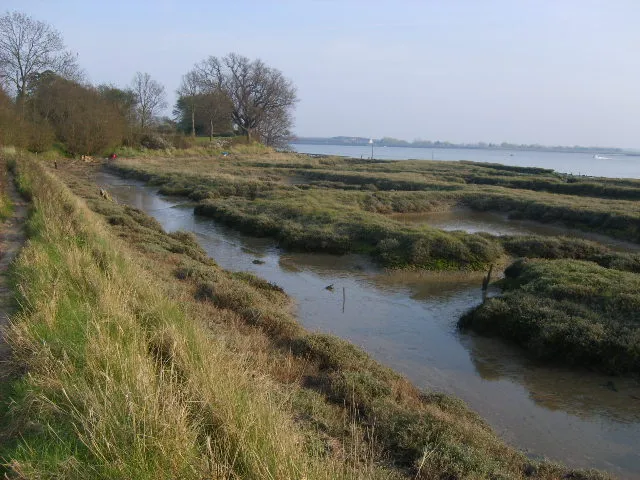
Photo: William Metcalfe, CC BY-SA 2.0, via Wikimedia Commons
Estuaries are Britain’s least stable landscapes. They are neither river nor sea, neither solid nor liquid. The tide arrives twice a day and redraws the boundary between land and water; mudflats that were walkable in the morning become channels by afternoon. It is little wonder that such places have gathered a folklore of their own. The estuary is a landscape of uncertainty, and uncertainty is the raw material of the eerie.
This is not a guide to ghost-hunting. It is a guide to reading the strange coast, and to understanding why the British estuary has proved such fertile ground for stories of drowned bells, lost villages, phantom lights and black dogs.
Why Tidal Uncertainty Feeds Horror
The estuary is a place where the map is provisional. Channels move; sands shift; sea walls are breached and rebuilt. Villages have been swallowed, ports silted up, churches abandoned to the marsh. The past is not securely buried in such places. It is held in mud, and mud gives things back.
There is also the matter of sound. An estuary is rarely silent: water, wind, birds, the knock and creak of boats. Folklore has long filled the gaps with bells. Drowned bells are a recurring motif around the British coast, said to ring beneath the water before storms or at particular tides. The bell is a useful ghost because it is heard rather than seen; it belongs to the acoustic uncanny of the shore.
The Severn: Bore, Bells and the Moving Shore
The Severn estuary is dominated by its bore, a tidal wave that travels upriver and can arrive as a wall of water. It is a genuine spectacle and a genuine hazard. Local folklore has long placed bells beneath the water, and the Severn’s shifting shores have swallowed land, boats and structures over centuries.
The Purton ships’ graveyard, on the Gloucestershire bank, is a more tangible curiosity: a collection of abandoned vessels used to shore up the bank, now half-buried in mud and grass. It is not a haunted site in any official sense, but it has the atmosphere of one. The river is wide, the light is flat, and the hulks look like the ribs of something larger.
The Humber: Ravenser Odd and the Lost Ground
The Humber estuary has its own drowned history. Ravenser Odd, a medieval port on the Yorkshire coast, was lost to the sea; its site is now associated with shifting sand and water. The story of a town swallowed by tide is a powerful one because it is true in substance: coastal erosion is not folklore but a continuing process.
The Humber’s sandbanks and channels have long been regarded as uneasy ground. Phantom lights are a common motif in marsh and estuary folklore, often explained as marsh gas or distant lamps, but the explanation does not entirely remove the effect. A light where no light should be is still a light where no light should be.
The Dee: Sands, Dogs and the Wirral Edge
The Dee estuary, between the Wirral and Flintshire, is a place of cockle beds, tidal channels and islands that are accessible only at low tide. Hilbre Island is the best-known example: a visit requires attention to tide tables and a readiness to turn back. The estuary is beautiful, but it is not forgiving.
Black-dog traditions are widespread in Britain, and the Welsh borderlands have their own versions. The black dog is a liminal creature, associated with roads, boundaries and lonely places. An estuary edge, where land becomes water and water becomes land, is exactly the kind of threshold such a figure might be expected to patrol.
The Thames Marshes: Sea Walls and Marsh Lights
The Thames estuary and its marshes have a long history of reclamation, sea walls and drowned pasture. This is a landscape of edges: ditches, embankments, grazing marsh and the wide grey water beyond. It is also a landscape that has attracted stories of marsh lights and solitary figures.
The Thames marsh is not the Gothic ruin of the tourist imagination. It is flatter, emptier and more administrative: a place of gates, paths and warning signs. That ordinariness can make the eerie more effective. A light moving across a field is less strange in a graveyard than on a managed marsh where every path is supposed to be accounted for.
An Eerie Traveller’s Notes
For readers drawn to strange coastal curiosities, the estuary rewards patience more than drama. Check tide tables before any walk; never attempt to cross mudflats without local knowledge; respect private land and conservation closures. The coastguard is not a folklore character, and the tide is not a metaphor when it is coming in.
Good starting points include the Severn’s Purton ships’ graveyard, the Humber’s wide skies and lost-town histories, the Dee’s tidal islands, and the Thames marshes’ sea walls and empty paths. Go in daylight, carry a map, and do not chase lights. The point is not to prove a ghost. The point is to stand where the land is provisional, and to feel how quickly the ordinary shore becomes strange.