Dread on Headed Paper: Why British Horror Trusts a Buff Envelope More Than a Fog
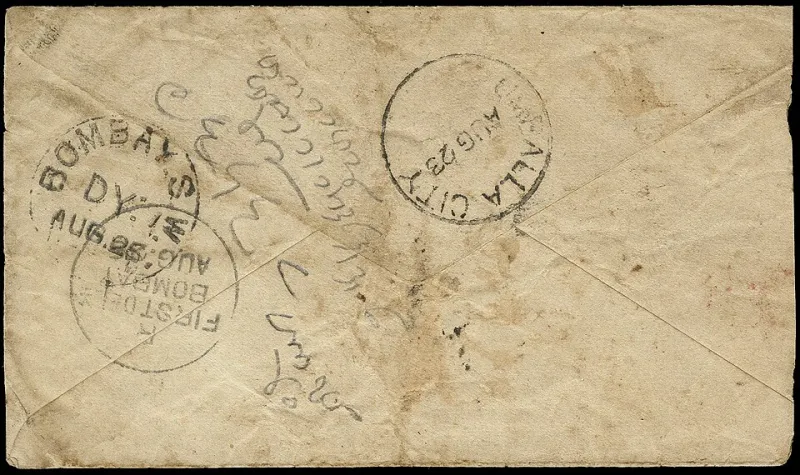
Photo: Unknown scribe, Public domain, via Wikimedia Commons
There is a particular sort of British dread that does not arrive in a hearse. It arrives in a buff envelope, second class, with a reference number in the top right-hand corner.
Ask a reader to picture the setting of a supernatural tale and the furniture is usually the obvious sort: a rain-lashed abbey, a corridor with too many doors, a village that has quietly fallen off the modern map. Yet a great many of the most durable British ghost stories are set somewhere far duller. A library counter. A solicitor's office. A committee room. A hotel register. Their terror is administered in the language of minutes, memoranda and subsection clauses.
The argument here is a simple one, and deliberately unfashionable: British supernatural fiction is at its most effective when it borrows the paperwork of ordinary administration. Dread, in this tradition, is most convincing when it arrives on headed paper.
The journal as a form of evidence
It is worth noting that the site's own namesake belongs to this lineage. Maupassant's Le Horla (1887) is not narrated so much as filed: a dated journal, kept entry by entry, in which a man records the slow collapse of his own certainty. The form does the work. Someone is keeping a log. The log is the only witness. When the final entry breaks off, the reader is left holding a document rather than a confession.
That instinct — horror as a paper trail — is not French so much as bureaucratic, and the British perfected it.
The catalogue card as a haunted object
M. R. James is usually praised for his antiquarianism, but his real innovation was clerical. Oh, Whistle, and I'll Come to You, My Lad (1904) opens with a booking, a letter and a name entered in a hotel list; its terror is scaled precisely to a man who will later have to check out and explain himself. The Tractate Middoth (1911) turns on a library catalogue entry that cannot be reconciled with the shelf. The librarian's competence is the hook; the failure of an indexing system is the fright.
James spent his professional life inside institutions — Eton, King's College, Cambridge — and his narrators write like examiners. Nothing is asserted that could not be minuted.
Case notes, timetables and the Board of Trade
Le Fanu's Green Tea (1869) is presented as a medical case, delivered by Dr Martin Hesselius, complete with a discussion of the patient's symptoms and habits. The story is a file with a cover sheet.
Dickens's The Signal-Man (1866) is more explicitly documentary still. The narrator takes down the man's account, as he says, as nearly as possible in his own words. The signalman consults his book; the rules of the railway company are quoted with the reverence of scripture. The horror does not disturb the timetable. It fits into it.
Arthur Machen's The Terror (1917), written under wartime censorship, is assembled from telegrams, letters, newspaper paragraphs and official statements. Machen understood that a nation at war reads its supernatural news in the same column as its casualty lists. Three-quarters of a century later, Ghostwatch (1992) achieved something similar on television: the scare depended less on the apparition than on the formatting of a live outside broadcast and the reassuring voice of a continuity announcer.
The file that will not close
What these works share is a suspicion that the ghost is not the real subject. The real subject is the system. A form implies a bureau; a bureau implies a policy; a policy implies that somebody, somewhere, has decided the situation is within tolerance.
British administrative history supplies genuine curiosities enough to sustain the mood.
Burial in woollen. Acts of 1666 and afterwards required the dead to be wrapped in wool rather than linen, in support of the domestic wool trade. Executors swore an affidavit before a justice of the peace, and many parish registers record in the margin that the requirement had been met. The consequence is a national archive in which the registers note, in ink, what a body was wearing in the ground. The state had views on the shroud, and it wrote them down.
The trial of Helen Duncan. The Witchcraft Act of 1735 was, in substance, a statute against pretending to supernatural powers. When the medium Helen Duncan was prosecuted in 1944, at a moment of considerable official nervousness, it was under that Act — a secular matter of fraud dressed in the language of conjuration. The Act was repealed in 1951 by the Fraudulent Mediums Act, which was itself repealed in 2008 by consumer protection regulations. Britain's ghosts, in the end, have been supervised by trading standards.
Detached parts. The Counties (Detached Parts) Act 1844 tidied up fragments of counties that lay entirely inside other counties — anomalies produced by centuries of inheritance. Before that legislation, a field could belong administratively to a parish several miles distant, and a householder might owe dues to a vestry he had never seen. There exist places that belonged nowhere convenient. That is an eerie concept, and it was produced by surveyors.
The museum report. In 1971, two carved stone heads were unearthed in a garden in Northumberland, and afterwards submitted for examination by specialists. The reply was, in effect, a shrug. It is the shrug that lingers: an object has been catalogued, assessed, and found to be of no special interest, and the paperwork says so in a tidy hand.
The Ministry of Defence files. Between 2008 and 2013 the Department's surviving records of alleged aerial sightings were transferred to The National Archives. Whatever one makes of the contents, the aesthetic is extraordinary: a light above a suburban rooftop rendered as an incoming letter, a reference number and a standard reply.
The aesthetic of the committee room
Contemporary British horror understands all this. Ramsey Campbell's Liverpool is a city of letting agents, launderettes and derelict cinemas, where the uncanny is indistinguishable from poor upkeep. Robert Aickman's stories turn on a tax inspector, a honeymoon itinerary, a holiday brochure. The terror in Aickman is very often the terror of a man simply doing his job, and doing it courteously.
Why the form still frightens
Three reasons, offered briefly. First, paperwork distributes responsibility: nobody has to be haunted if everybody has merely signed. Second, official language flattens the supernatural into procedure, and a flattened ghost is somehow worse than a shrieking one — it suggests the thing has been assessed. Third, a document is evidence, and evidence can be misfiled. An unread file is a haunting that has been suffered and never noticed.
So when a British horror story begins with a letter, a register or a notice pinned to a door, do not treat it as a gentle opening. It is a threat. Someone has taken the trouble to write it down, and the writing down is the worst part.