The Steeple in the Drought: Drowned Parishes and the Bells Beneath the Water
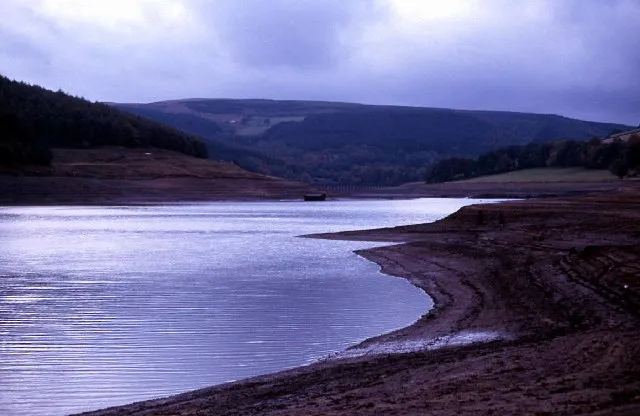
Photo: Lynne Kirton, CC BY-SA 2.0, via Wikimedia Commons
The reservoir is not a natural absence. It is an absence with paperwork. When the water is low and the drawdown line cuts a pale band along the bank, the visitor at Ladybower may see foundations, field boundaries and the stumps of hedges where Derwent and Ashopton once stood. The effect is less that of a ghost appearing than of a map being consulted in public. What was drowned has not vanished; it has been kept, in suspension, under a body of water that never quite persuades the mind to forget the parish beneath it.
A Village Held in Suspension
The story of Britain’s reservoir villages is usually told as a story of sacrifice. Derwent and Ashopton were cleared in the 1930s and 1940s to create Ladybower Reservoir for the growing water needs of the East Midlands. Mardale Green was lost beneath Haweswater in the 1930s, its farms and churchyard displaced so that Manchester could drink. Capel Celyn, in the Tryweryn valley, was flooded in the 1960s for Liverpool’s supply, a decision that became a byword for Welsh grievance and cultural loss. These are not remote legends. They are recent enough to be remembered by families, and old enough to have acquired the patina of folklore.
The travelogue impulse is strong here. A walk along the reservoir edge becomes an exercise in reading absence: a wall that once divided fields, a bridge parapet, a lane that now ends in water. At Haweswater, the valley has the particular silence of a place that was emptied rather than abandoned. At Llyn Celyn, the water carries a political charge that no amount of scenic framing can neutralise. The drowned village is never merely picturesque. It is a landscape with a minute taken against it.
The Bell as Survivor
The most persistent motif in the folklore of drowned parishes is the bell. Stories gather around submerged churches whose bells are said to ring beneath the water, sometimes on still nights, sometimes before a storm, sometimes only to those who have reason to listen. The tales are rarely precise. They do not agree on which bell, which village or which hour. That vagueness is part of their durability. A bell is an instrument of timekeeping and summons; to hear one under water is to hear the parish refusing to accept that its hours are over.
It is important to say that no reputable survey records a submerged bell ringing in Ladybower or Haweswater. The folklore does not require verification. Its power lies in the way it turns an engineering fact into a ghost-story premise. The bell is not a ghost. It is a relic of communal time, and the imagination clings to it because the alternative — silence — is too administrative. A drowned village with no bell is simply a reservoir with foundations. A drowned village with a bell is a place that still keeps its own calendar.
Drought and the Return of the Map
Drought makes the story literal. In 1976, and again in later dry spells, the remains of drowned villages became a minor national spectacle. Walls surfaced; gravestones and foundations were photographed; visitors walked where roads had run. The return is always temporary, and that is precisely what gives it its eerie force. The village is not restored. It is exhibited, then covered again. The water resumes its role as the official version of the landscape.
This is why the drowned parish is such a potent image in British eerie fiction. It offers a ready-made structure for the uncanny: a place that is both present and withdrawn, known and unavailable, mapped and inaccessible. The ghost story does not need to invent a haunting. It needs only to describe the drought. The horror lies in the interval between the exposed wall and the returning water — the moment when memory is permitted to walk about, before the reservoir closes over it again.
The Politics of Forgetting
There is a temptation to treat these places as merely atmospheric, and that temptation should be resisted. Capel Celyn was not a fairytale village. It was a living community, and its drowning was contested. The reservoir is a monument to a decision about whose water, whose land and whose future counted. To speak only of bells and steeples is to risk turning a political loss into a decorative one. The eerie is most honest when it admits the paperwork behind the water.
The same is true of Mardale and the Derwent valley. The drowned parish is not a natural relic but a managed one. Its reappearances are governed by rainfall, demand and the operational needs of the water company. The ghost, if there is one, is bureaucratic before it is spectral. It appears when the levels fall and disappears when the tap is turned.
What the Ghost Story Knows
British horror has long understood that the most unsettling places are not those that have been abandoned but those that have been repurposed. The drowned village is a masterclass in this. It is a parish, a reservoir, a heritage site and a warning, all at once. The bell beneath the water is its most economical symbol: a sound that cannot be located, a summons with no congregation, a clock that no one can wind.
Perhaps that is why the image endures. The drowned villages of Britain are not simply places we have forgotten. They are places we have chosen to store under water, and the folklore of the ringing bell is a way of saying that storage is not the same as erasure. When the drought comes, the map returns. When the water returns, the bell goes under again. Between the two, the visitor stands on the bank and listens for a parish that exists only in old records and in the stories we tell about what the water keeps.