The Note That Will Not Resolve: Britain’s Humming Places and the Sound Beneath the Survey
Photo: Tom Ackroyd, CC BY-SA 4.0, via Wikimedia Commons
It begins, as these things tend to, with an ordinary domestic detail. A resident of a coastal town, or a 1970s estate on the edge of a Midlands city, notices that the house is not quite silent at eleven o’clock at night. There is a note in the air: low, level, unvarying. It is not loud enough to wake anyone, but it is present enough to prevent sleep. Put your head to the wall and it is there. Stand in the garden and it is fainter. Step back indoors and it returns, patient as a fridge, though the fridge has been switched off and the house has been checked.
The reports accumulate. Bristol has had its hum, reported and argued over since the 1970s. Largs, in Ayrshire, had one that drew academic attention in the 1990s. Hythe, Southampton, various suburbs of south Wales and the north of England — each has produced a small literature of complaint, a correspondence in the local paper, a handful of residents who cannot sleep and a larger number who hear nothing at all. The word used locally is usually just that: the Hum, capitalised, as though it were a fixture of the parish.
A Note With No Player
What is remarkable about the hum is not its volume but its refusal to belong to anything. An aircraft passes; a boiler fires; a lorry downshifts on the bypass — these are sounds with a source and an end. The hum has neither. It is the acoustic equivalent of a sentence missing its subject.
Descriptions vary but rhyme. A deep drone, like a distant generator. A vibration felt rather than heard, in the teeth, in the floorboards, in the bones behind the ear. Some hear it chiefly at night, which may say as much about ambient noise as about the phenomenon itself. Some hear it only in certain weather. Some describe it as a pressure, a thickening of the air, a sensation of a large room being occupied next door.
For a fear to take hold, it need not be supernatural. It need only be unresolved.
And in Britain, where a great many strange experiences are filed under practical headings, the hum has the additional quality of sounding infrastructural. It resembles a substation, a pumping station, a wind turbine turning at low revolutions in still air. It is the sort of noise that ought to have an address, a ratepayer and a maintenance schedule.
What the Instruments Miss
There are good technical reasons why a hum might be hard to trace. The frequencies involved are often low — in the region below a few hundred hertz, sometimes edging into infrasound beneath the threshold of hearing. Standard sound-level meters, weighted to match human hearing, tend to report such noise as negligible while the resident continues to be disturbed. Low-frequency sound also travels. It passes through walls, windows and the fabric of a building with comparatively little loss, so that the person in the kitchen may be hearing something generated streets away, or through ground rather than air.
Investigations, when they come, are methodical. Environmental health officers attend, take readings, ask about plant rooms, extractor fans and refrigeration. Sometimes they find the culprit and a service engineer is dispatched: a compressor on its last bearings, a fan with a worn mount, an industrial unit running overnight without permission. The complaint is closed, the noise abates, and the town returns to its ordinary silence.
Sometimes they do not. Sometimes the readings are inconclusive, the source unidentified, the disturbance below the threshold of legal action. And here the hum ceases to be a nuisance and becomes something else: a phenomenon without an owner, sustained by nothing that anyone can point to.
The Paperwork of a Drone
British law is, on the whole, unromantic about noise. A statutory nuisance requires a source, an unreasonable interference and, in practice, somebody to serve a notice upon. Where the source cannot be found, the machinery of complaint grinds to a halt — not through indifference but through the plain fact that there is nothing to measure against, no premises to visit, no responsible person to write to.
The hum therefore drifts out of the administrative world and into the domestic one. People unplug appliances at the mains. They lay ear to skirting boards and photograph their own walls. They sleep in spare rooms, buy earplugs, replace boilers. They learn that the sound is worse in the small hours and better after rain. They develop, without wishing to, a private expertise.
And they discover the social fracture that follows. Some neighbours hear it; some do not. Those who do not may be politely sceptical, then less politely so. Those who do begin to suspect that they are being humoured. A street in which the matter is raised at a residents’ meeting is never quite the same street afterwards.
Two Neighbours, One Sound
This, more than any instrument reading, is where the eeriness lies. The hum divides a place into two populations living at the same address: those for whom the air is occupied and those for whom it is empty. The experience is not shared, only reported. There is no way of demonstrating it to a person standing a metre away, no way of proving that the note is in the room rather than in the listener.
Ghost stories have always understood this asymmetry. The figure at the end of the corridor is visible to one witness and to nobody else; the sound in the empty house is heard once and then denied. The hum arrives with the same structure already built in — a private perception in a public place, doubted by everyone except the person who has to sleep in it.
Maupassant, whose Horla is a study in exactly this kind of solitary conviction, understood that the horror is not the presence itself but the impossibility of producing it as evidence. The hum offers a modern version. It is not a spirit; it is a residue. It has no biography, no former address, no reason to be there. It is simply an audible fact that declines to be entered into the record.
The Hum as Local Lore
Given enough years, an unexplained noise stops being a complaint and becomes a piece of local custom. It acquires a name, a set of anecdotes and a rough map. It is worst along this terrace and not that one. It began after the new depot was built, or long before it. It followed the closing of the works. It can be heard by dogs.
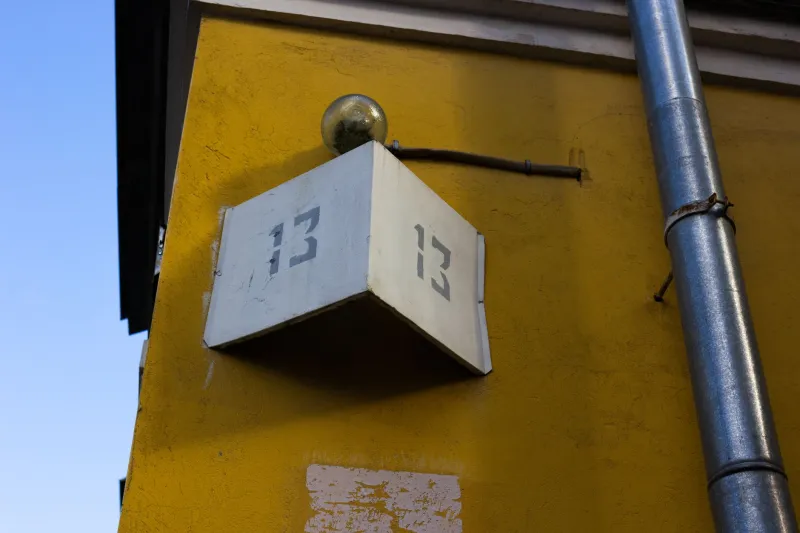
None of these claims can easily be checked, and it does not matter. What matters is that the hum has been absorbed into the ordinary speech of a place, as the ghost light is absorbed into the language of theatres and the absent thirteenth house into the language of streets. Britain is unusually good at this. We file the strange under the practical, then talk about it for forty years.
Listening, Deliberately
The temptation, on encountering such a story, is to solve it. To drive out with a microphone, locate the fan, close the case and pronounce the town quiet. There is certainly satisfaction in that, and engineers have earned it many times over.
But the hum retains its grip precisely because a residue so often remains. Something is heard; nothing is found; the hearing continues. An ordinary place is quietly altered, not by a visitation but by a vibration, and the people within it learn to live alongside a sound that will not resolve.
If you should find yourself in such a place, it is worth standing still for a moment and listening properly. Not to identify the note, but to notice how quickly a drone becomes a presence — and how readily the mind supplies a player for a sound that has none.