The Lamp Left Burning: Britain’s Empty Stages and the Ghost Light Habit
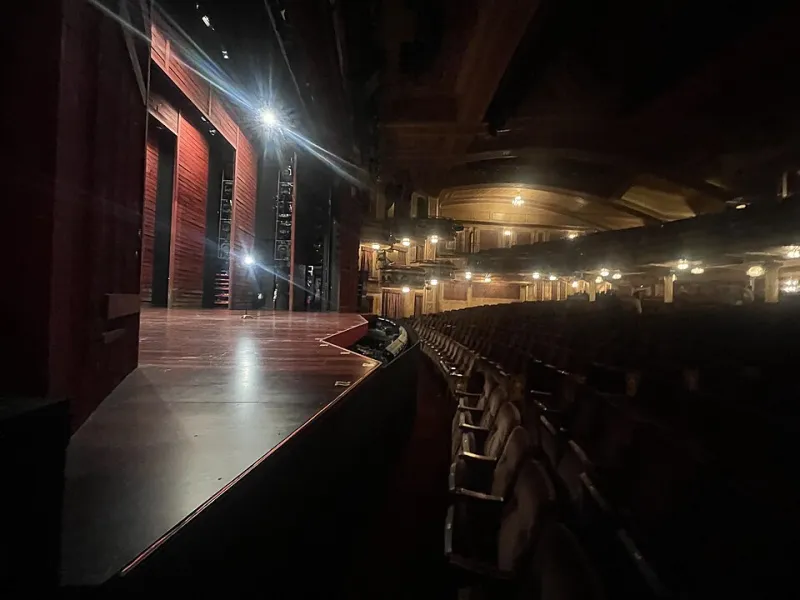
Photo: Averywlms, CC BY-SA 4.0, via Wikimedia Commons
There is a particular hour in a theatre when the audience has gone, the bars have been shuttered, and the stage door has been locked from the inside. In the stalls, the seats are stacked with the detritus of the evening: a dropped programme, a discarded glass. And on the stage, at the centre, a single bare bulb burns on a metal stand. It is not there for the actors. It is not there for the audience. It is, depending on whom you ask, either a piece of fire-safety housekeeping or a small act of appeasement.
The Practical Lamp
The ghost light — as it is almost universally known — has a history more mundane than its name. In the gas-lit theatres of the nineteenth century, a small flame was sometimes left burning overnight to consume residual gas and reduce the risk of explosion. When electricity replaced gas, the practice survived in a different form: a single lamp left on stage so that anyone entering the auditorium in darkness — a cleaner, a stage doorman, a late-working technician — would not stumble into the orchestra pit or fall from the stage edge. The Theatres Trust and various licensing authorities have long recognised the value of a low-level light in an otherwise dark auditorium; it is a sensible precaution, not a superstition.
Yet the practical explanation has never quite displaced the other one. Ask a stage manager why the light is on, and you will often get a shrug and a sentence that begins, “Well, officially...” The official reason is safety. The unofficial reason is that the theatre is not empty.
The Unseen Company
The folklore of the ghost light is remarkably consistent across Britain. Every theatre, it is said, has its ghost. Some are famous — the Man in Grey at the Theatre Royal Drury Lane, the unlucky actor at the Adelphi — and some are known only to the staff, a presence felt in the wings or a cold spot on the stairs. The ghost light, in this telling, is a courtesy. It allows the dead to perform. It is a lamp left on for someone who never takes a bow.
Regional rep theatres, converted music halls and village halls that double as playhouses all tell versions of the same story. In one West End house, a former stagehand is said to walk the fly floor on quiet nights; the light is left on so he can find his way. In a converted chapel in the West Country, the story is of a woman in a grey dress who appears in the second row when the building is dark; the bulb is kept burning for her. These are not claims that can be verified, and the people who tell them rarely insist on their literal truth. They are stories that have attached themselves to a practical object, the way ivy attaches to a wall.
What is notable is how seriously the ritual is observed. The light is not switched off casually. In some theatres, the last person out is responsible for checking it; in others, the duty falls to the stage doorman, who will walk the stage before locking up. To forget the light is considered bad luck — not because a ghost will be angry, but because the theatre will feel wrong. A dark stage is a stage that has been abandoned. A stage with a single bulb burning is a stage that is merely resting.
The Bulb That Will Not Die
There is a sub-genre of theatre anecdote concerning the bulb itself. Staff at several British theatres claim that the ghost light has outlasted the fittings, the wiring and the electricians who installed it. One story, told in various forms, concerns a bulb that was installed in the 1970s and has never been replaced; another concerns a lamp that flickers when certain actors walk past, but only in rehearsal. These are the kind of stories that flourish in the hothouse atmosphere of a theatre, where a long run breeds familiarity and familiarity breeds folklore.
It is tempting to dismiss such tales as whimsy. But they serve a purpose. The ghost light is a reminder that the theatre is a building with a memory. It has seen thousands of performances, and it will see thousands more. The light is a small continuity in a profession built on ephemera.
The Last One Out
In 2026, the ghost light remains a fixture of British theatre life, from the largest West End playhouses to the smallest touring venues. It is mentioned in health and safety guidance, and it is mentioned in the same breath as the superstitions about Macbeth and the whistle in the dressing room. It is both a practical object and a piece of folklore, and it does not seem to mind the contradiction.
Perhaps that is the point. The ghost light is not for ghosts. It is for the living — for the stage doorman who has to cross the stage at midnight, for the technician who has left a cable coiled in the wings, for the actor who wants to believe that the applause has not quite died. It is a lamp left burning in an empty room, and it says only this: someone was here, and someone will be here again.