A Timetable for the Unquiet: Riding Britain’s Night Buses After Midnight
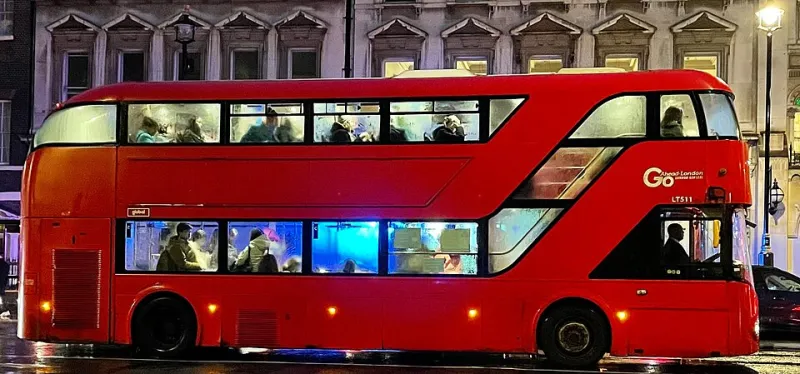
Photo: Filippo antinori1223, CC BY-SA 4.0, via Wikimedia Commons
The night bus is a moving haunted house with a fare table. It has thresholds, corridors, a bell that summons attention and a driver who is not supposed to look back. Its horror is not gothic but procedural: the timetable promises that something will arrive, and the empty seat suggests that something already has.
British cities after midnight are not usually described as haunted. They are described as quiet, or poorly lit, or badly served by public transport. Yet the night bus has become one of the most reliable settings for the modern ghost story. Not because bus depots are ancient or because routes follow ley lines, but because the bus is a narrative machine. It collects strangers, confines them, moves them through the dark and releases them at stops that may or may not be real.
The Upper Deck Is a Room Without Witnesses
The upper deck of a night bus is a room with no obvious purpose except seating. During the day it is full of schoolchildren and shopping bags. After midnight it becomes a place of speculation. The windows are black mirrors. The lights are too bright. The staircase is a threshold that can be watched from below, but not easily policed.
In horror terms, the upper deck is where the story happens because it is where the passenger cannot be supervised. The driver is downstairs, separated by a partition and a mirror. The other passengers are either absent or asleep. The upper deck is therefore a room without witnesses, and a room without witnesses is a room where anything can be believed.
The bell is the crucial detail. A bell pressed on an empty upper deck is one of the great small sounds of British dread. It is not a scream. It is a request. It says: I am here, and I would like to get off. If no one is there, the request becomes a question, and the question hangs in the air until the next stop.
Lit Stops, No One Waiting
The night bus route is punctuated by illuminated shelters. A lit stop with no one waiting is not unusual. It is, in fact, the ordinary condition of the city after midnight. But the empty shelter has a peculiar power in narrative because it looks like a stage set. The light is on, the timetable is displayed, the bench is empty. It is waiting for someone.
This is where the ghost who misses their stop becomes useful. The figure is not necessarily dead. They may simply be late, or lost, or uncertain of the route. But in the logic of the night bus, a passenger who does not alight becomes a passenger who cannot alight. The bus moves on. The stop recedes. The timetable continues to promise a service that the passenger can no longer use.
The Driver’s Mirror
The driver is the bus’s custodian, not its narrator. The route is fixed, the timings are tight, and the mirror above the cab is a small rectangle of responsibility. Drivers are trained to check it, but in the stories passengers tell, the driver will not look. The mirror becomes an object of restraint. What is behind the driver is not to be acknowledged.
This is not a supernatural rule. It is a narrative one. The driver who does not look allows the upper deck to remain unknown. The driver who does look risks seeing something that cannot be reconciled with the timetable. The horror of the night bus is therefore not the ghost itself, but the professional calm that refuses to confirm it.
A Moving Haunted House
The bus is a corridor with doors. It stops, opens, closes and moves on. Each stop is a threshold, each passenger a possible intrusion. Unlike the graveyard, the night bus does not wait for the visitor to arrive. It travels through ordinary streets, past takeaways and office blocks, and it does so on a schedule. The horror is not that the bus is lost. The horror is that it is exactly on time.
The moving haunted house is an old idea, but the night bus gives it a municipal register. There is no fog, no crypt, no ancestral curse. There is a vehicle, a route and a fare. The ghost is not a figure in a sheet. It is a passenger who has been carried past their stop, or a stop that appears on no map, or a bell that rings from a seat that was empty a moment ago.
Why the Timetable Beats the Graveyard
A timetable creates expectation, and expectation is the engine of dread. The last bus is a deadline. The night bus is a promise that the city will still function after dark, but it is also a reminder that the city is not obliged to function for everyone. The route is public, but the experience is private. The passenger sits in a lit box and watches the streets go by, and the streets do not watch back.
That is why the night bus makes better horror than the foggy graveyard. The graveyard is designed to be spooky. The night bus is designed to be useful. When the useful thing becomes strange, the strangeness is harder to dismiss. The upper deck is empty, the stop is lit, the bell has rung, and the driver is not looking in the mirror. The timetable says the bus will arrive. It does not say who will be on it.