The Stamp, the Slip, the Silence: Britain’s Libraries and the Readers Who Never Quite Returned
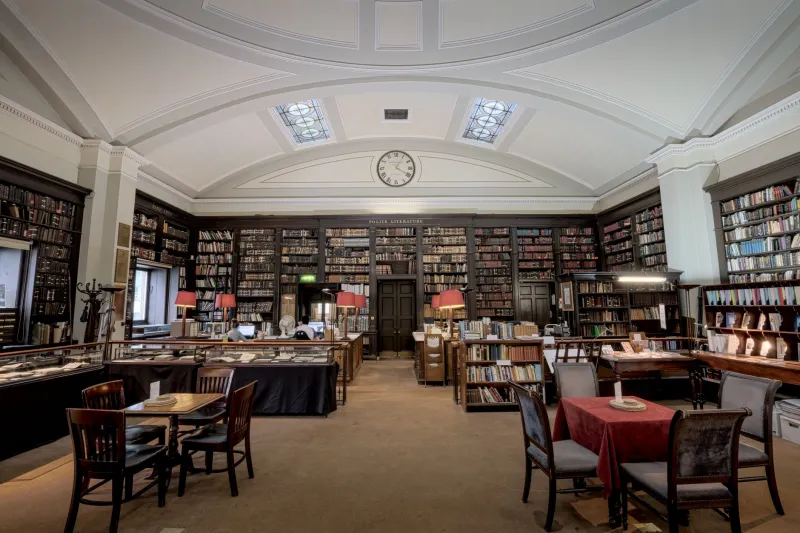
The public library is one of Britain’s most disciplined rooms. Its shelves are ordered, its catalogues are indexed, its notices are printed in the same reassuring typeface whether they announce a reading group or a closure. Yet it is also one of the country’s most quietly haunted institutions. Not because every reference section needs a spectre, but because a library is a place where objects are lent, handled, annotated and returned by people who may never be seen again. The book is a witness. The date stamp is a record. The overdue notice is, in its small bureaucratic way, a letter from the past.
The Contract and the Breach
To borrow a book is to enter into a contract. The reader takes a temporary custodianship; the library extends a measured trust. There is no oath, only a slip, a scanner or a stamp. The transaction is civil, almost bland. That is precisely what gives the late return its peculiar charge. An overdue book is not a crime; it is a failure of timing. It suggests a reader who meant to return, who perhaps moved house, fell ill, forgot, died, or simply kept the volume beside a bed for longer than the rules allow.
In this sense, the overdue notice belongs to a minor genre of administrative ghost story. It arrives with a date, a title and a fine, and it addresses a person who may no longer be the same person who borrowed the book. The language is polite because the system cannot know what has happened. “Our records show” is a phrase with a hollow at its centre. The records show a transaction; they cannot show the life around it.
What the Date Stamp Records
Older library books carry their history in ink. A date stamp, pressed into a ruled slip at the back, is a sequence of small proofs: this book was here, then here, then here. The columns do not explain themselves. They record a rhythm of borrowing without narrative, and that is why they are so suggestive. A gap of decades between stamps is not a story, but the mind supplies one. The book waited on a shelf, or in a box, or on a landing, while the world outside the library changed its telephone codes and its bus routes.
Marginalia deepen the intimacy. A pencilled line beside a sentence, an initial in the corner of a page, a corrected typo, a pressed bus ticket used as a bookmark: these are not official records, but they are evidence of attention. The next reader inherits them without consent. A library copy is therefore a palimpsest, though not a grand one. It is a communal object marked by private moments. The residue is not supernatural in any conventional sense. It is simply the trace of other minds having been present, and of the book having been the place where they paused.
Reservation slips have a similar power. In older systems, a slim card might carry a borrower’s number, a date and the title requested. The slip is a promise of future reading, a queue made material. When it remains tucked inside a book that has long since left the reservation shelf, it becomes a small relic of anticipation. Someone wanted to read this. Someone was waiting. The waiting has outlasted the request.
The Library as a Haunted Institution
British horror has always understood that libraries are good settings for unease. M. R. James’s “The Tractate Middoth” begins in a library, and its dread grows from the proximity of catalogues, readers and obscure volumes. The library is not frightening because it is dark; it is frightening because it is orderly. Silence makes every small sound legible. Classification implies that everything has a place, which raises the possibility that something might be in the wrong one.
The public library adds a civic dimension. Carnegie libraries, municipal reference rooms and postwar branch libraries were built as instruments of improvement, and their architecture often retains a solemn, slightly institutional quiet. They are places where the state offers knowledge without charge, and where the individual is trusted to behave. The ghost story thrives on that trust. A figure in a reading room is unnerving not because it is monstrous but because it is out of sequence. It has no borrower number. It does not return.
The Ethics of Return
When a book comes back after many years, the library must decide what to do with it. The fine may be waived; the record may be amended; the volume may be withdrawn, repaired or returned to the shelf. The administrative response is sensible, but it cannot quite answer the imaginative one. The book has travelled through time. It has been read by hands that may no longer exist. Its return is a small resurrection, and also a small disappointment: the mystery closes, the stamp is added, the object becomes ordinary again.
Marginalia present a related problem. Is an annotation vandalism, a gift or a haunting? Librarians tend to prefer clean copies, and rightly so. Yet the reader who finds a previous reader’s comment in the margin is encountering a form of correspondence. It is not addressed to them, but it arrives anyway. The library is a commons, and the commons is never entirely silent.
A Quiet Sort of Ghost Story
In 2026, the public library remains one of the few British institutions where strangers share resources with minimal ceremony. That ordinariness is what makes it eerie. The overdue book is not cursed. The date stamp is not a sigil. But both belong to a system in which the living and the absent are recorded in the same ledger, and in which a borrowed object can carry the residue of every reader before you.
The ghost in the library is rarely a figure in a white sheet. It is the gap between stamps, the pencilled initial, the reservation slip left in a book that was never collected. It is the notice that begins “Our records show” and ends with a request for return. The library keeps its silence, and the silence keeps its readers.